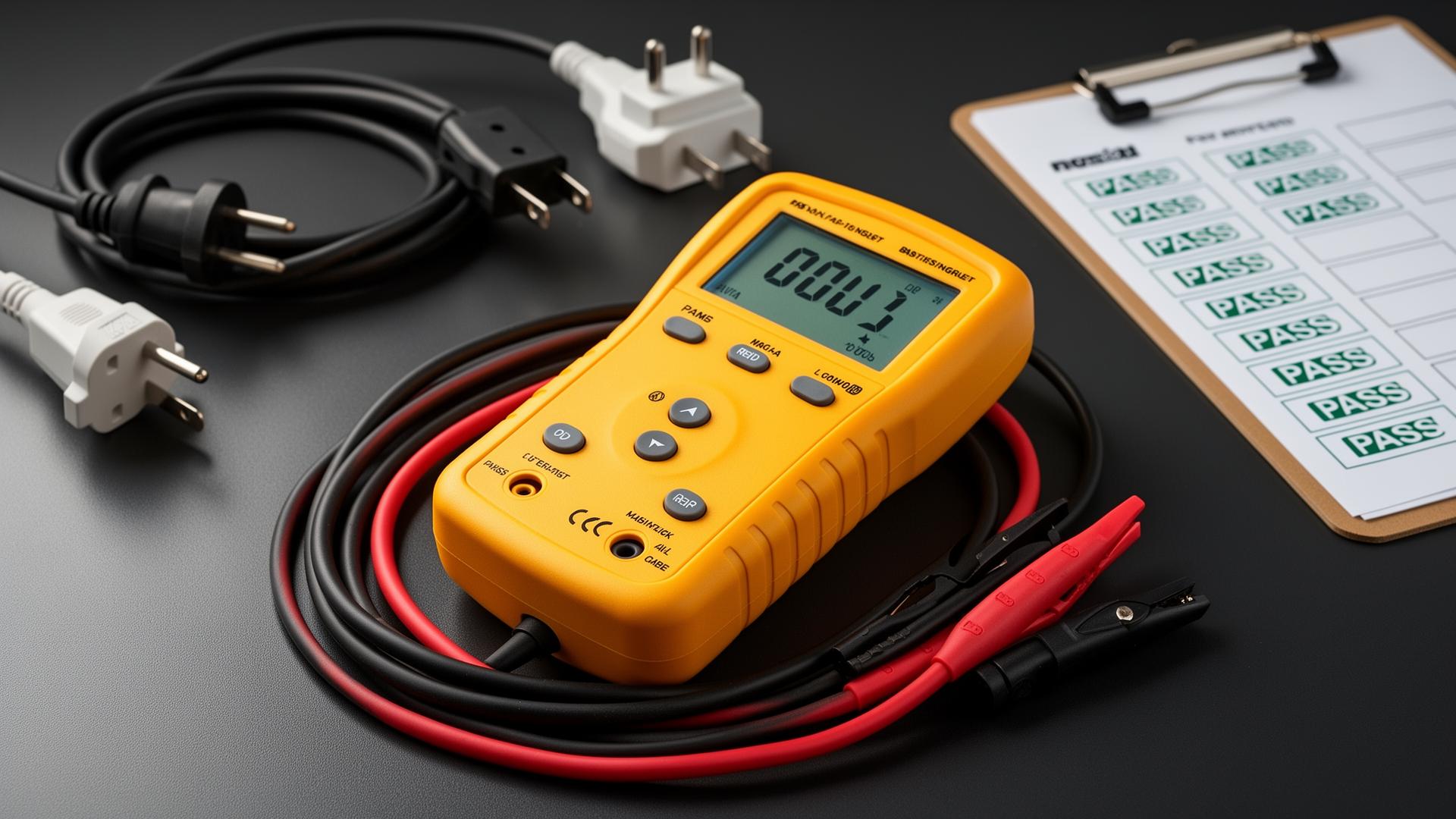
Portable appliance tester with leads and PASS labels for PAT testing
South Wales & Bristol

Portable Appliance Testingwith Digital Certificates &Asset Registers

Every appliance individually tested, labelled, photographed and added to your digital asset register, so when an inspector or insurer asks, the proof is one click away.

Trusted by landlords, developers & letting agents across South Wales & Bristol.
15+
Years on the tools
BS 5839
Certified to standard
24–48h
Typical callout window
100%
Insured & DBS-checked
Service overview

PAT Testing, explained without the jargon

What it is

Combined visual and electrical inspection of portable, movable and stationary appliances under the IET Code of Practice (5th Edition), producing a per-appliance pass/fail record.

Who it's for

HMO landlords (legally required in licensed HMOs in Wales since 2022), offices, shops, schools, hospitality, manufacturers, anywhere employees or tenants plug in equipment supplied by the duty-holder.

When it's needed

On new tenancies in HMOs, at intervals set by the risk assessment (typically 12–24 months), after equipment repair, or after relocation that may have damaged a flex.

Why professional matters

Defective portable equipment is a leading cause of electrical fires. PAT testing finds the failing kettle before it ignites the kitchen, and proves the duty-holder did their job.

The cost of ignoring it

What an inspector finds when there is no PAT record

Risks if left unchecked

  • Internal cabling pinched in a flex grip, invisible until insulation resistance is measured.
  • Damaged plug pins still in service after being kicked out of a socket.
  • Class I appliances with broken earth continuity, the case becomes live on first fault.
  • Extension leads daisy-chained to feed unrated loads, a classic ignition source.

Common mistakes

  • Sticker-only PAT visits with no insulation resistance readings recorded.
  • Testing only the appliances on the day, missing tenant-owned items not declared.
  • Testing without an asset register, no way to prove what was and wasn't checked.
  • Skipping the visual inspection because the electrical test 'passes'.

Wales HMO PAT testing is mandatory under the 2022 regulations. No record = no defence after an incident, and an open door for licence enforcement.

Our process

A clear path from enquiry to certificate

  1. Step 1

    Pre-visit inventory

    We agree a rough item count and a sensible appointment window, typically one engineer can complete 70–100 items per day in occupied spaces.

  2. Step 2

    Visual inspection

    Every item checked for damage, suitability and correct fuse rating before any electrical test.

  3. Step 3

    Electrical test

    Earth continuity, insulation resistance and polarity tests using calibrated PAT testers; results stored per appliance, not just pass/fail.

  4. Step 4

    Labelling

    Pass labels with date, engineer ID and next-test date; failed items removed from service or repaired on site where safe.

  5. Step 5

    Asset register & certificate

    Digital register with appliance ID, location, test results and photo, plus a top-line certificate for the duty-holder.

Why clients stay with us

Specific, measurable benefits

Legal compliance

Wales HMO Regulations 2022, EAW Regulations 1989, PUWER 1998, one visit, all bases covered.

Insurance evidence

Asset register accepted by every UK commercial insurer we have ever been asked to evidence to.

Per-appliance traceability

Failures are traced to the exact item, not just a building total.

Minimal disruption

Engineers work around tenants and staff; appliances are unplugged for 30 seconds, not hours.

Fixed price

Per-item pricing published before the visit. No 'we're here, might as well charge extra' surprises.

Multi-site portal

Letting agents and portfolios see next-due dates and certificates per property in one screen.

Technical detail

Everything that goes into a proper pat testing

PAT testing is misunderstood, most cheap visits skip the electrical readings entirely and just slap stickers on. Below is what a compliant 5th-edition Code of Practice test actually involves.

Class I vs. Class II appliances

Class I appliances rely on an earth conductor for safety and must be earth-continuity tested. Class II appliances are double-insulated and tested for insulation resistance only. Misclassifying a Class I as a Class II is the most common report falsification we see.

Test intervals, how often

There is no single statutory interval. Risk-based intervals from the IET Code of Practice typically give: offices 12–48 months, hotels and HMOs 12–24 months, construction site equipment 3 months. Tenant-supplied items in HMOs should be tested at every tenancy change.

Microwave leakage testing

Microwave leakage is a separate test, required in catering and HMO kitchens; failure can mean prolonged low-level exposure to occupants. We carry the meter on every visit.

Lead and extension testing

Detachable leads (kettle leads, IEC leads) and extension reels are tested as individual items with their own asset ID. A failed lead must not be reissued to a passed appliance.

Battery-powered and USB-charged items

Battery products themselves are out of scope; their chargers and docking stations are in scope and tested as Class II at the plug end.

Failed items, what we do

Minor failures (damaged plug, frayed flex) repaired on the spot for items the duty-holder owns; otherwise removed from service with a written report. Tenant items never repaired without consent.

Frequently asked

Frequently asked questions

It is the most practical way to comply with the Electricity at Work Regulations 1989. In licensed HMOs in Wales it has been a specific legal requirement since 2022.
Related services

Often paired with pat testing

Ready to make pat testing one less thing to worry about?

Free survey, fixed-price quote within 48 hours, and certified work delivered when we said we would.

Covering South Wales & Bristol