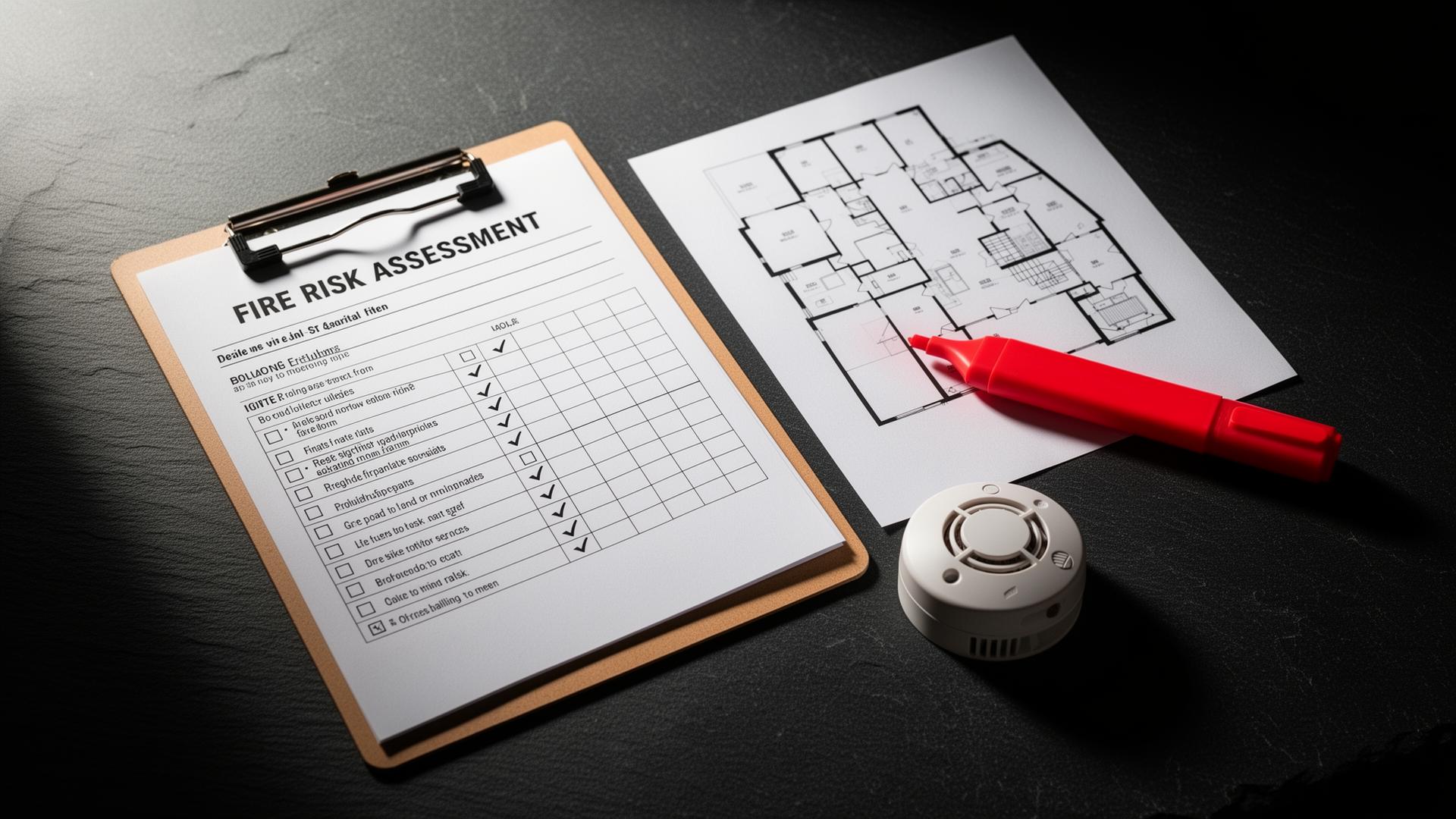
Fire risk assessment clipboard with checklist, floor plan and smoke detector
South Wales

Fire Risk Assessments(Type 1–4) Aligned to theRegulatory Reform Order

A fire risk assessment that an enforcing officer can actually use, significant findings prioritised, action plan dated, and a written re-assessment trigger so you know when it expires.

Trusted by landlords, developers & letting agents across South Wales.
15+
Years on the tools
BS 5839
Certified to standard
24–48h
Typical callout window
100%
Insured & DBS-checked
Service overview

Fire Risk Assessments, explained without the jargon

What it is

A structured, written assessment of the fire risk in a building under the Regulatory Reform (Fire Safety) Order 2005, carried out to PAS 79 methodology by a competent assessor and signed against named premises.

Who it's for

The 'Responsible Person' for any non-domestic premises and the common areas of any HMO or block of flats, landlords, employers, building owners, managing agents and freeholders.

When it's needed

Annually for higher-risk premises; every 1–3 years otherwise; immediately after a fire, a near-miss, a layout change, or a change of occupancy.

Why professional matters

The RRFSO 2005 requires a written FRA for premises with 5 or more occupants. Without one, the Responsible Person is in breach the moment the building opens.

The cost of ignoring it

Why most FRAs we review are not enforceable

Risks if left unchecked

  • Generic templates with no premises-specific findings, every property has the same 'medium' rating.
  • No action plan with names, dates or accountability, findings sit unactioned for years.
  • No re-assessment trigger date, Responsible Person doesn't know the FRA is out of date until enforcement arrives.
  • Compartmentation not surveyed, the single most important fire-safety control on flats and HMOs.

Common mistakes

  • Buying a £75 'online FRA' for a 12-bed HMO. They do not stand up to enforcement review.
  • Treating the FRA as a one-off document rather than a living record.
  • Not following up on significant findings, the FRA itself becomes the evidence of negligence.
  • Excluding the loft, the basement, the bin store and the external escape, all common omission points.

After a serious incident, the FRA is the first document the fire authority requests. A template-only FRA accelerates prosecution rather than defending against it.

Our process

A clear path from enquiry to certificate

  1. Step 1

    Pre-visit pack

    We review your existing FRA (if any), drawings, fire alarm certificates and EICR before attending, saves you paying us to read on site.

  2. Step 2

    Type 1–4 walkthrough

    Common parts, escape routes, fire-resisting construction, alarm provision, lighting and signage, sampled to the agreed FRA type.

  3. Step 3

    Compartmentation survey

    Visual or intrusive sampling of flat entrance doors, ceilings, service penetrations and roof-space separation, flagged as required by your FRA type.

  4. Step 4

    Significant findings

    Each finding prioritised P1–P3 with a target completion date, a named responsibility and an estimated cost band.

  5. Step 5

    Issue & review trigger

    Full PAS 79 report delivered digitally with a written re-assessment trigger date. We diary the review reminder for you.

Why clients stay with us

Specific, measurable benefits

Enforceable findings

Written to PAS 79, accepted by South Wales Fire & Rescue and Welsh local authorities on inspection.

Actionable plan

Every finding has a date, a name and a cost, not just 'consider further'.

Continuity

We re-assess against the previous report so progress is visible, not a clean-slate every visit.

Compartmentation included

Type 2 and Type 4 assessments include intrusive sampling, we do not subcontract this and we do not skip it.

Integrated with our other services

Where we also install or service your alarm, FRA findings feed straight into the service brief, no duplication.

Fixed price

Per-unit or per-floor pricing published before the visit. No per-finding fee.

Technical detail

Everything that goes into a proper fire risk assessments

Fire risk assessment is structured by the four PAS 79 types depending on how invasive the survey is. The right type for your premises depends on use, occupancy and known historical issues.

Type 1, common parts, non-destructive

Standard FRA for blocks of flats and small HMOs. Reviews escape routes, alarm, lighting, signage and visual evidence of compartmentation. Does not include intrusive sampling. Suitable as a baseline assessment for low-rise, low-risk properties.

Type 2, common parts, destructive sampling

Includes intrusive sampling of compartmentation in agreed areas, typically following building-fabric concerns. Required where Type 1 findings indicate possible compartmentation defects.

Type 3, common parts and flats, non-destructive

Extends Type 1 into a sample of flats, escape doors, smoke alarms, flat entrance door condition. Common after a near-miss or change of management.

Type 4, common parts and flats, destructive

The most comprehensive, combines Type 2 and Type 3 with intrusive sampling in flats. Typical after a fire incident or where remedial works are planned.

Higher-risk buildings (HRB)

Under the Building Safety Act 2022, buildings 18m+ or 7+ storeys have additional duties. We refer those out to a specialist HRB-registered assessor and do not pretend we can sign them off ourselves.

Review frequency

Higher-risk premises: annual. Most HMOs: 1–2 years. Lower-risk commercial: up to 3 years. Always re-assess after a fire, near-miss, change of use or significant layout change.

Frequently asked

Frequently asked questions

Yes, the Regulatory Reform (Fire Safety) Order 2005 requires a written FRA for any premises with 5 or more occupants, plus the common parts of any HMO or block of flats.
Related services

Often paired with fire risk assessments

Ready to make fire risk assessments one less thing to worry about?

Free survey, fixed-price quote within 48 hours, and certified work delivered when we said we would.

Covering South Wales