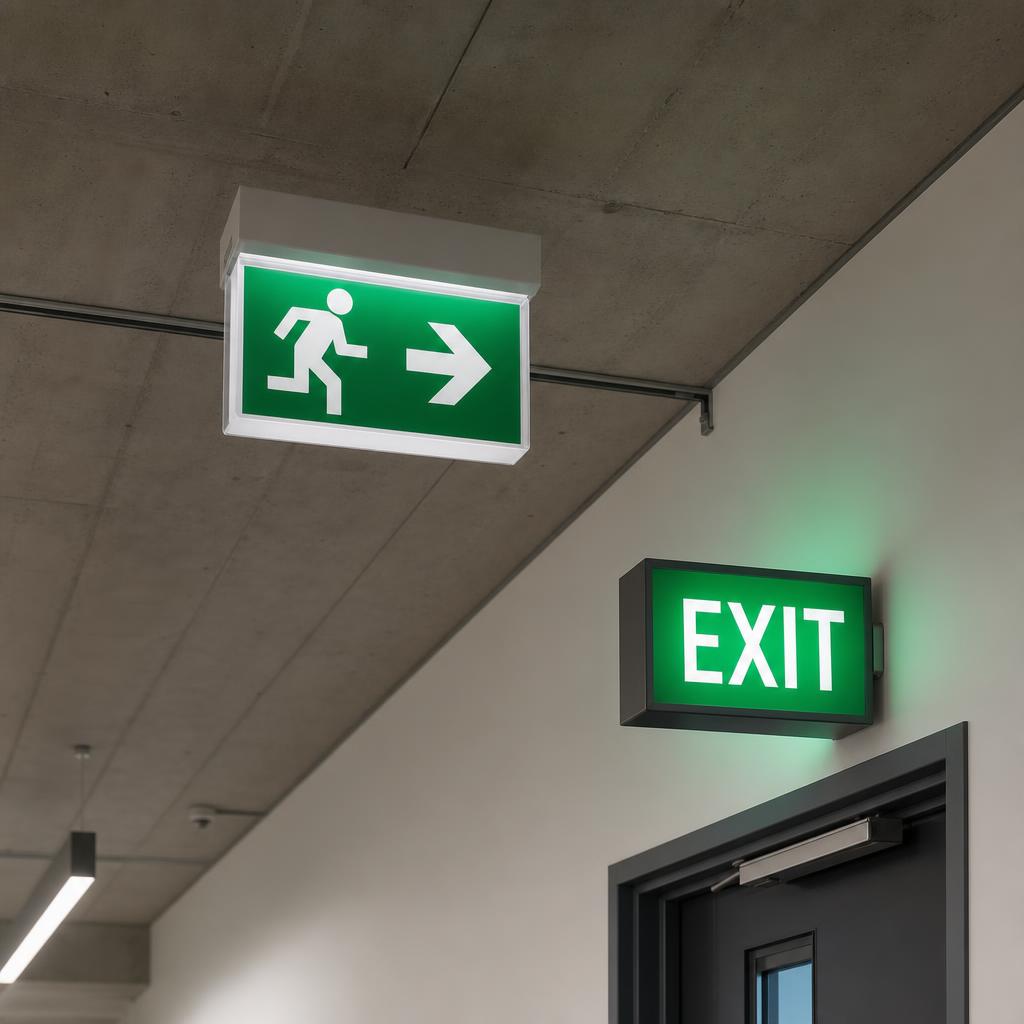
Illuminated green emergency exit light fixture in a commercial corridor
South Wales

BS 5266 EmergencyLighting Design,Install & Testing

When the power fails, your escape routes have three seconds to light up, and three hours to stay lit. We design, fit and certify the system that delivers exactly that.

Trusted by landlords, developers & letting agents across South Wales.
15+
Years on the tools
BS 5839
Certified to standard
24–48h
Typical callout window
100%
Insured & DBS-checked
Service overview

Emergency Lighting, explained without the jargon

What it is

Battery-backed emergency lighting designed to BS 5266-1, installed at escape routes, open areas, plant rooms and high-risk task areas, and tested to a documented annual schedule.

Who it's for

HMO landlords, commercial occupiers, offices, retail, hospitality and any premises where the public or staff need to escape if mains lighting fails.

When it's needed

On all licensable HMOs, after any fire risk assessment that identifies escape-route lighting as a control measure, on new fit-outs, and after a change of layout that affects escape routes.

Why professional matters

A dark escape route turns a manageable evacuation into a crush incident. The system is cheap; the absence of it is not.

The cost of ignoring it

Where emergency lighting fails inspection

Risks if left unchecked

  • Batteries that no longer hold the required 3 hours, the lamps come on, then die after 20 minutes.
  • Fittings that have aged out (10-year design life) and now fail discharge tests at random.
  • Coverage gaps at staircase changes of direction, final exits and external escape routes.
  • No documented annual discharge test in the log book, fails fire risk assessment review.

Common mistakes

  • Treating emergency lighting as 'just bulbs' rather than a tested life-safety system.
  • Disabling fittings during refurbishment and forgetting to reinstate them.
  • Using non-self-contained kitchen-shop LED downlighters with no certification.
  • Logging only the monthly flick-test, never the annual 3-hour discharge.

Fire and rescue officers carry a torch into your stairwell. So should your tenants, except they don't, because the building should light their way out.
Our process

A clear path from enquiry to certificate

  1. Step 1

    Survey

    Walk every escape route with the fire risk assessment open, map exit signs and high-risk task areas, identify any blackspots.

  2. Step 2

    Design

    Lux-level design to BS 5266 (1 lux at escape route centre-line, 5 lux at points of emphasis), with a fitting schedule and fixed quote.

  3. Step 3

    Install

    Self-contained LED fittings as standard, with addressable self-test where it pays back inside 5 years. Wired to the local landlord's lighting circuit.

  4. Step 4

    Test & commission

    First 3-hour discharge witnessed and recorded, every fitting individually labelled, BS 5266 commissioning certificate issued.

  5. Step 5

    Annual testing

    We diary the annual discharge test, run it, log results to your portal and issue the BS 5266 certificate the same day.

Why clients stay with us

Specific, measurable benefits

Compliance

Designed, installed and tested to BS 5266, accepted by every UK licensing scheme we work with.

Low energy

LED fittings draw under 3W each and last 50,000+ hours.

Self-test option

Addressable self-test fittings remove the monthly flick-test burden and pay for themselves on portfolios above ~20 fittings.

Tested batteries

We log the date of every battery so end-of-life replacement is forecast, not a surprise after a failed discharge.

Integrated with fire alarm

Where useful, we tie discharge testing into the fire alarm system's planned service so disruption is once per visit, not twice.

Portfolio reporting

Multi-site landlords see all properties' next-due dates in one portal screen.

Technical detail

Everything that goes into a proper emergency lighting

Emergency lighting is governed by BS 5266-1 (design and install) and BS EN 50172 (the testing regime). Below is how we apply both to the property types we work with most often.

Lux levels and coverage

Minimum 1 lux maintained at the centre-line of all escape routes; 5 lux at points of emphasis (stair landings, changes of direction, final exits, fire-fighting equipment, first-aid points). Open areas above 60 m² require anti-panic lighting at 0.5 lux average over the floor.

Maintained vs. non-maintained

Maintained fittings stay lit at all times, useful for exit signs in hospitality and assembly buildings. Non-maintained activate only on mains failure, used for HMO escape routes and back-of-house corridors.

Self-contained vs. central battery

Self-contained is standard for HMOs and small commercial, each fitting has its own battery. Central battery suits large sites and gives 8-year-plus battery life but requires regulated rooms and quarterly inspection of the central unit.

Self-test and addressable systems

Self-test fittings flash their own status LED monthly; addressable systems report by exception to a central panel. For HMO portfolios with 20+ fittings, addressable pays back in saved monthly inspection labour inside 5 years.

Testing regime under EN 50172

Monthly: brief function test of every fitting. Annually: full duration discharge test (3 hours for most premises) with every fitting individually verified. We carry out and certify both. Many clients handle their own weekly visual checks in between, which is common practice.

Common upgrade triggers

10-year fitting age, battery failure rates above 10% on annual discharge, new partition walls that change escape route geometry, or a fire risk assessment that downgrades the existing system.

Frequently asked

Frequently asked questions

BS EN 50172 requires a brief monthly function test and a full 3-hour discharge test annually. We carry out and certify both. Many clients also run their own weekly visual checks in between visits, which is common practice.
Related services

Often paired with emergency lighting

Ready to make emergency lighting one less thing to worry about?

Free survey, fixed-price quote within 48 hours, and certified work delivered when we said we would.

Covering South Wales