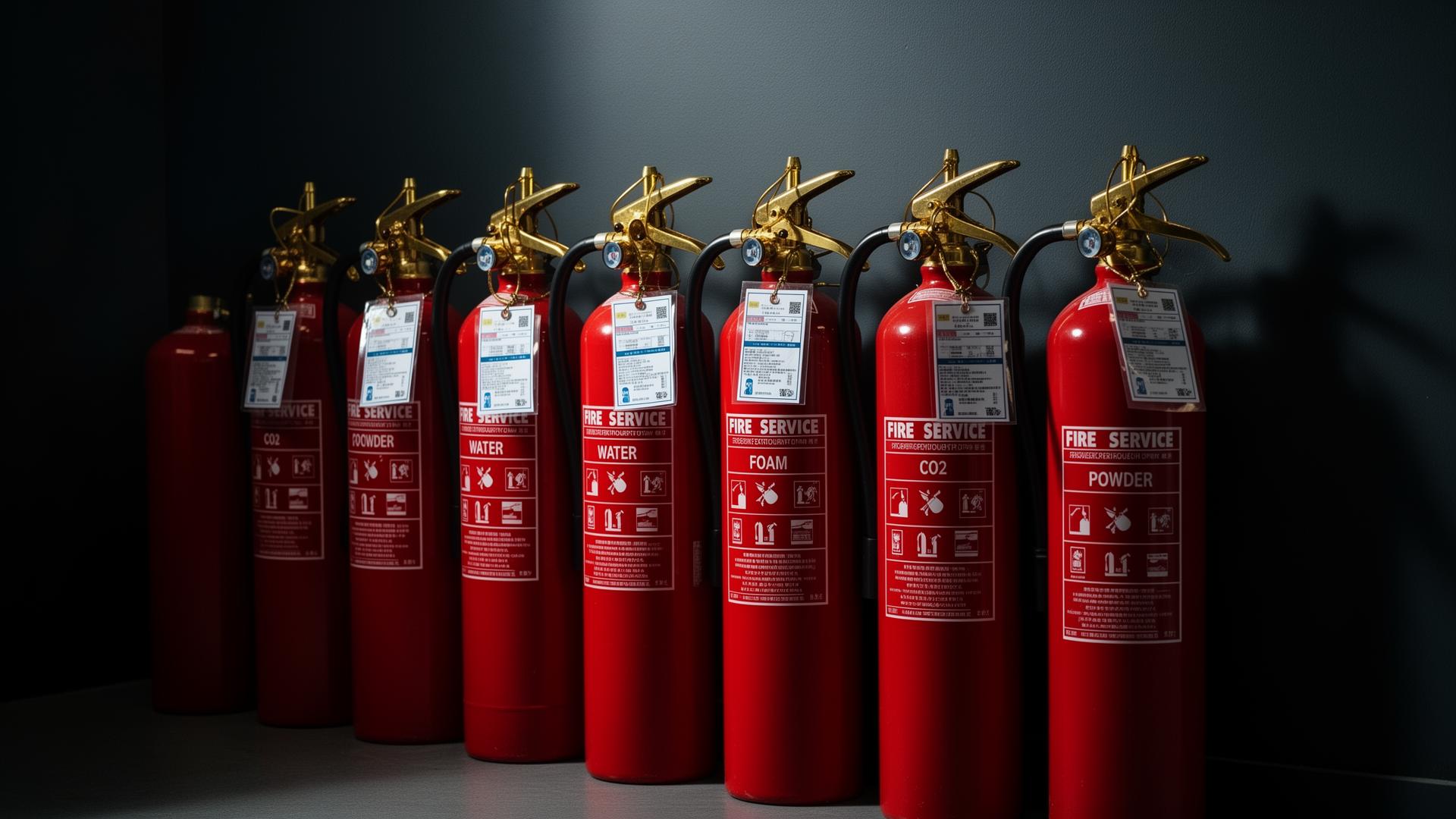
Row of serviced red fire extinguishers, CO2, water, foam and powder, with service tags
South Wales

Fire Extinguisher Supply,Commissioning &Annual Servicing

The right extinguisher in the right place, signed off by an engineer who actually understands what your premises need, and serviced every year on the date we promised.

Trusted by landlords, developers & letting agents across South Wales.
15+
Years on the tools
BS 5839
Certified to standard
24–48h
Typical callout window
100%
Insured & DBS-checked
Service overview

Fire Extinguishers, explained without the jargon

What it is

Selection, supply, commissioning, annual servicing, extended servicing and replacement of portable fire extinguishers under BS 5306-3 and BS 5306-8.

Who it's for

Any premises with a workforce, public access or hazardous processes, offices, retail, hospitality, light industrial, commercial kitchens and HMO common parts.

When it's needed

On a fit-out, after a fire risk assessment, at change of tenancy, at annual service date, and at the 5-year extended-service and 10-year overhaul / replacement intervals.

Why professional matters

The right extinguisher used in the first 30 seconds prevents most workplace fires from reaching alarm-activation point. The wrong one, or an empty one, makes the fire worse.

The cost of ignoring it

What we find when we take over from cheap servicing

Risks if left unchecked

  • Water extinguishers fitted next to electrical risers, wrong medium, lethal in use.
  • Empty CO2 cylinders never weighed at service, engineer signed but never lifted them.
  • Out-of-test cylinders past 10 years and well into a brittle-failure window.
  • Wall brackets missing or extinguishers parked on the floor where they cannot be located in smoke.

Common mistakes

  • Buying online and self-installing without commissioning, voids manufacturer warranty.
  • Using one extinguisher type 'because it covers most fires', it doesn't.
  • Skipping annual service in years 2, 3 and 4 because 'we used the 5-year overhaul'.
  • Treating extinguishers as decor, wrong location, wrong height, wrong signage.

After an incident, the insurance loss-adjuster's first question is which extinguisher, where, and last serviced when. Three numbers, and they are either on the certificate or they are not.
Our process

A clear path from enquiry to certificate

  1. Step 1

    Survey

    Walk every floor, identify hazards (Class A, B, C, D, F, electrical), confirm correct media and number to BS 5306-8.

  2. Step 2

    Supply & commission

    BAFE-registered extinguishers supplied, wall-mounted at the correct height, ID signage fitted, BS 5306 commissioning certificate issued.

  3. Step 3

    Annual service

    Visual inspection, weight check, gauge verification, hose and horn condition, anti-tamper seal renewal, service label dated and signed.

  4. Step 4

    5-year extended service

    Discharge test and full overhaul for water, foam and powder; CO2 hydrostatic testing at 10 years.

  5. Step 5

    Replacement & disposal

    End-of-life cylinders removed and disposed of legally under hazardous waste rules, paper trail provided.

Why clients stay with us

Specific, measurable benefits

Right extinguisher, right place

Specified to BS 5306-8, not 'one red one and a CO2 in the corner'.

Every cylinder weighed

CO2 and powder weights recorded at every service, not just visual.

Combined visits

Where we service your fire alarm, extinguishers go on the same visit, one engineer, one disruption window.

Plain commissioning paperwork

BS 5306 commissioning certificates that an insurer can verify in 10 seconds.

Honest end-of-life advice

We tell you when replacing is cheaper than overhauling, and quote both so you can decide.

Multi-site portal

All extinguisher next-service dates across your portfolio in one screen.

Technical detail

Everything that goes into a proper fire extinguishers

Choosing and maintaining portable extinguishers is governed by BS 5306-8 (selection and installation) and BS 5306-3 (commissioning and servicing). The notes below set out how we apply both.

Fire classes and the right media

Class A (paper, wood, textile), water or foam. Class B (flammable liquids), foam or powder. Class C (gases), powder. Class D (metals), specialist powder. Class F (cooking oils), wet chemical. Electrical risks, CO2 or dielectrically-tested water mist. We fit the medium your hazards actually need.

Travel distances and coverage

BS 5306-8 sets maximum travel distances of 30m for Class A and 10m for Class B. We map your floors and place extinguishers accordingly, not at convenient wall hooks.

Wet chemical and commercial kitchens

Wet chemical extinguishers (Class F) are mandatory in any kitchen with a deep-fat fryer. They smother burning oil safely; powder and CO2 do not and will scatter the burn.

P50 service-free extinguishers

P50 composite extinguishers carry a 10-year service-free guarantee with annual visual inspection only, useful for portfolios with high service-visit overhead. We quote conventional and P50 side-by-side so you can compare 10-year cost.

Vehicle and industrial extinguishers

We service van-mounted, plant and industrial extinguishers including those subject to PSSR 2000 hydrostatic testing.

Signage and floor stands

Photoluminescent ID signs above every extinguisher and floor stands where wall-mounting is impractical. Compliance for refurb projects without drilling tiled walls.

Frequently asked

Frequently asked questions

Annual basic service under BS 5306-3, plus extended service at 5 years (water, foam, powder) and at 10 years for CO2. We diary all three.
Related services

Often paired with fire extinguishers

Ready to make fire extinguishers one less thing to worry about?

Free survey, fixed-price quote within 48 hours, and certified work delivered when we said we would.

Covering South Wales